Rating agencies, including Standard and Poor’s, Moody’s and Fitch, use different, proprietary models to rate debt and financial strength. While there may be no such thing as a perfect model, each company promotes its own model and methodology. Rating agencies serve a purpose in providing the marketplace with information on the financial health of the companies, governments and financial instruments they rate.
Taking into account differences in models (and agency inclinations), it is not surprising that rating agencies should differ in their ratings from time to time. Thus, Standard and Poor’s downgraded the United States credit rating from AAA to AA+ while Moody’s and Fitch have maintained their ratings while warning that future downgrades were possible if the United States did not enact debt reduction measures and if the economy weakened.
A more definitive statement would have been made if all three major rating agencies had dropped the rating of United States debt.
Standard and Poor’s rating change reflects their perception of the political stasis leading up to the recent move to raise the debt limit.
The Standard and Poor’s downgrade remained in place after a $2 trillion dollar error in their calculations was discovered by the Treasury department. Standard and Poor’s defended their decision, reinforcing the perception that the downgrade reflected to a large degree the inability of our government to get the job done.
Standard and Poor’s is under attack for their rating of mortgage backed securities involved in the financial debacle of 2008. These securities were rated AAA just prior to their default. The U.S. Justice Department is investigating Standard and Poor’s for their ratings of these instruments.
The ratings process is complex. Complex models are involved. When the ratings model indicates problem areas indicating a potential downgrade a number of paths may be taken. A rating agency may work with the organization to solve its problems (or to assure the model is adequately capturing an organization’s weaknesses and strengths). Either way, the focus is to assure capital adequacy.
This may give the organization an opportunity to avoid a downgrade while fixing the problem and risk a potential disastrous cascade into insolvency. There is a balance of risks -- a cascading failure could be a far worse alternative both for the organization , related entities and the economy. However, measures taken to solve the underlying problems should be appropriate, rather than window dressing which overvalues assets or undervalues liabilities.
If the agency does not downgrade an organization (or financial instrument), they risk a potential hit to their reputation if the entity does tank while holding the original, pristine rating.
In many instances companies pay a significant fee to be rated. This raises the issue that the agencies are serving the companies they rate rather than the overall public (or potential investors). This issue is to some degree offset by the reputation issue that rating agencies face when they fail to downgrade a company (or financial instrument ) that fails. Their services are judged by their ability to accurately rate entities.
The actual downgrade aside, Standard and Poor’s was correct in its appraisal of the ineffectiveness of our government in addressing the national debt issues. Standard and Poor’s mentioned the political brinksmanship, differences between political parties, and the failure to consider tax increases among other issues.
The sad thing is that our elected representatives performed so horribly that it gave Standard and Poor’s an opportunity to downgrade government debt from AAA for the first time in the history of the United States. There are many that depend on the United States to provide a stable financial milieu; the threat of a default; the inability of some representatives to compromise was an arrogant abrogation of their electoral duty to act in the best interest of the United States.
It seem that the rating agencies are, in a way, a force unto themselves that rest above governments and pass judgement upon them. Do we really want the institution of money to rule us in this way?
Wikipedia article on 2011 downgrade.
Entitlements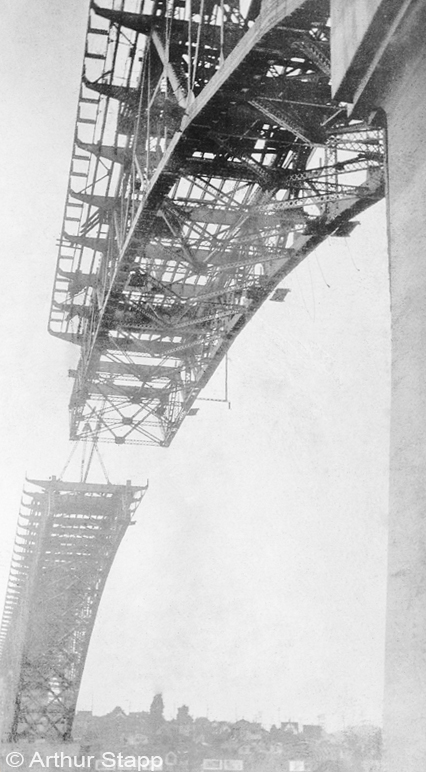 Completing the George Washington Memorial Bridge (Aurora Bridge-SR99), Seattle, Washington, 1932 (B&W)This photo of the George Washington Memorial Bridge (Aurora Bridge or SR 99) was taken by my father as it was being completed in 1932, during the period of the Great Depression. It was converted to black and white. Connecting Seattle’s Queen Anne Hill to Fremont, spanning over the Lake Washington Ship Canal, the Bridge’s construction was an engineering accomplishment in the midst of hard times. A bridge spans an obstacle to bring two areas together, to allow passage. It may be used symbolically in others areas such as a music bridge, an interlude that connects two parts of a song, or a bridge loan (interim financing).For me, it also symbolizes bridging the gap between work and retirement. In these days before the August 2, 2011 deadline to raise the national debt limit, it also symbolizes the need to bridge the gap between parties, to compromise on a solution to our national debt problem. Should that attempt fail, it will symbolize solutions to solve the financial gap.As we march towards a potential default of the national debt, a large part of the debate centers around the impact that entitlements have on our nation’s expenditures. Entitlements consist of Social Security, Medicare and Medicaid. Entitlements have grown to comprise a large portion of our nation’s expenditures and contributions to our nation’s burgeoning national debt. Social Security comprised 20% of the nation’s 2010 fiscal year budget while Medicaid and Medicare together comprised 23% (Wikipedia). Together, the three programs comprised 43% of the nation’s 2010 fiscal budget. Moreover, the cost of these three programs are expected to grow over the coming years. With such a considerable portion of our nation’s budget tied up in entitlement programs, it is difficult to find areas to cut. If you leave entitlements alone, you are left with 57% of the budget. If military expenses (20%) are left untouched, only 37% of the budget is left to work with.Historically, the concept of cutting Social Security has been likened politically to touching the electrified “third rail”. Social Security, Medicare and Medicaid have a storied history and a large degree of public need and acceptance (and entitlement) that makes them difficult to reduce.There has been a greater willingness to tackle the issue of entitlement programs in the recent national debt talks; however such endeavors may leave a sense of disconnect with the public who may be unaware of the cuts should they actually occur.There are many factors reflected in the increases in entitlement costs (and their projected costs into future years). One common factor is demographics.Demographics
Baby boomer demographics is a major reason for the increase in entitlement costs now and into the future. Baby boomers are considered to be those individuals born between 1946 and 1964, following World War II. There was a peak in births during that time period that has resulted in increased proportions of individuals for that cohort as the cohort has progressively moved down the arrow of time from birth to retirement. Consider a snake that has swallowed a mouse for dinner; you can see the progress in the snake’s digestion of the mouse as the mouse’s shape progresses down the long sleek lines of the snake’s body. In a demographic diagram, the baby boomer population exhibits somewhat similar characteristics, impacting each age group disproportionately as it ages.Thus, the increased birth rate during the baby boomer years results in increased expenses as baby boomers age. These increased older populations will stress entitlement programs, with fewer younger workers to provide the population base to pay for benefits for the older population.The ChallengeThe projected growth in entitlement spending represents a real challenge, and must be faced by creative solutions that address the problem for not just the immediate future, but for the long term. Such solutions must address needed social needs while at the same time managing costs.
 Mt St Helens crater and Toutle River, Cascade Range, Washington, 2011 (image on Photoshelter)Discussions between Congress and the White House regarding raising the National Debt Limit are an example of the considerable political risks in our current system. My concern is that failure to agree on a solution to raise the debt limit may cascade into financial disaster. It is a balance-of-risks issue that our leaders will ultimately be judged on.Political risk issues include:
- The polarization of political parties such that the more extreme elements dominate each party, and become nominated for office, crowding out the moderates.
- The emergence of non-elected individuals ‘asking’ that candidates sign ‘pledges’ which politically tie candidates to certain positions, limiting their flexibility to act.
- The inability of politicians to act in the interest of the nation.
Politicians need to be able to consider the best interest of the nation as a whole. Their inability to do so jeopardizes our nation. The clear and present danger is that the United States will default on its debt on August 3, 2011 if the national debt limit is not raised by that time.Should the United States default on its debt, there would be serious ramifications. Ratings agencies have already given warnings regarding our debt rating. In this July 14, 2011 Bloomberg story, Moody’s placed the United States’s Credit rating under review for a downgrade. In this July 16, 2011 LA Times article, Standard and Poor’s has also warned that they may cut the United States’s top AAA debt rating as a result of the lack of an agreement to raise the debt limit. In an article in Reuters 7/18/2011, Moody’s stated that the United States should “eliminate its statutory limit on government debt to reduce uncertainty among bond holders”. A decrease in the United States’s ratings by rating agencies would likely result in an increase in the interest rate that our country pays on our debt. This would increase the cost of financing the United States debt and also have reverberations throughout the marketplace, driving up interest rates generally. Failure to raise the debt limit could conceivably cascade into a financial catastrophe.The seriousness of what could be a cascading financial disaster is brought home by an article in the Insurance Journal: S&P Threatens Downgrade of Insurers, Financial Firms Over Debt Ceiling” indicating that S&P could downgrade a number of financial institutions should the government fail to act to raise the debt limit.Currently, Treasuries are regarded as “risk-free” currencies. Should our Government’s rating be downgraded they and other government securities may well be assessed higher capital charges in regulatory and rating agency models. The securities would included various securities including Fannie Mae and Freddie Mac, the latter two key to the mortgage market. Increased capital charges may potentially result in financial institutions being downgraded by rating agencies. If a financial institution is so downgraded as a result of the government failing to act on the national debt, it could trigger other events. “Ratings triggers” in the financial institution’s policies could be triggered, allowing a large withdrawal of policyholder funds from large investors, perhaps at book value,An increase in the interest rate would have impact in the marketplace, in valuation of assets, in home and auto loans and refinancings. It would alter institutional and personal behavior. Depending on the size of the interest rate increase, an increase in rate could impact stable value funds that promise payout at book value. Importantly, it would cost more to finance the United States debt with a higher interest rate.Treasuries have been long regarded as ‘safe’ and it is be “interesting” to speculate how changes in their quality rating would reverberate throughout the financial marketplace in the event the U.S. government fails to raise the debt limit by August 3, 2011.President Obama does not want to “kick the can down the road” instead preferring a longer term solution to the problem that includes spending cuts and revenue increases. The Republicans do not want to consider revenue increases. Some have signed a pledge not to increase taxes and are constrained by that.The danger is that the United States will default on its debt on August 3, 2011 if it does not raise the debt limit. We have an examples in history where one small thing cascaded into a major calamity. One event that comes to mind is the Great Seattle Fire of 1889 where glue boiling over into a gasoline fire ignited wood chips and eventually burned down 32 blocks of Seattle, including business district, wharves and railroad terminals.Do we want our government leaders shackled by the bounds of rigid ideology, watching the debt limit “glue pot” boil over into the “incendiary” market of interest and credit risk, cascading into a market conflagration that “burns” many in our economy? I would hope our leaders get wise and come to an agreement that will avert disaster in our financial markets. Maybe I am wrong. Maybe these risks won’t materialize or will do so to a minor extent. However it is uncharted waters and do you want to bet the farm that the serious risk will not materialize? President Obama needs to consider a short term deal that gets us over this deadline. The Republicans need to consider raising taxes, even if it means violating a pledge not to raise taxes.In 2012 the voters will hold our leaders accountable if they watched the pot boil over into the flames and cascade into disaster when they could have come to agreement.It is an issue of balance-of-risks. The risks of watching the debt pot boil over and cascade into a financial conflagration over over some ideological shackles are just not worth it.

Nuclear reactor technology has allowed the world-wide use of nuclear reactors for energy production. With the world faced with mounting carbon dioxide levels and global warming a concern, nuclear energy provides a low carbon emission alternative to traditional energy sources (World Nuclear Association and MIT study). This aspect of nuclear energy makes it a very attractive energy alternative. With President Obama wishing to expand the United States nuclear power plant program, the question becomes an issue of balance-of-risks.Accelerating nuclear reactor development provides a low carbon emission energy source; however there is risk associated with the use of nuclear materials. If we do not take advantage of nuclear’s low carbon footprint and instead pursue other, higher carbon footprint strategies, we risk exacerbating global warming issues. There are other options, as well, such as cleaner technologies, emerging energy technologies and reducing fertility rates to decrease population size.We seek to understand the low probability, high impact, long-tail risks associated with the use of nuclear materials. Since the dawning of the nuclear age, mankind has worked to harness the power of the atom. There have been many benefits from the use of radionuclides. However, there are risks as well.Risk areas to consider in looking at nuclear energy include:- Economic, including Externalities
- Design and Construction
- Natural Disasters
- Operations and Management
- Political and Regulatory
- Terrorism, War and Sabotage
- Radioactive Waste Treatment and Storage
We have had experience with nuclear accidents that display some of that high impact, long-tail risk. Previous blog articles have discussed Chernobyl, Three Mile Island and Fukushima (3/12/11, 3/25/11 and 3/28/11).We have seen historical flooding on the Missouri River which threatened Fort Calhoun Nuclear Plant and Cooper Nuclear Plant in Nebraska. Recently we have seen the large Las Conchas Wildfire threaten the Los Alamos Energy Department facility in New Mexico. These situations, including those situations where facilities were threatened but not breached, are all reminders that radiation is a serious risk and not simply an abstract probability.