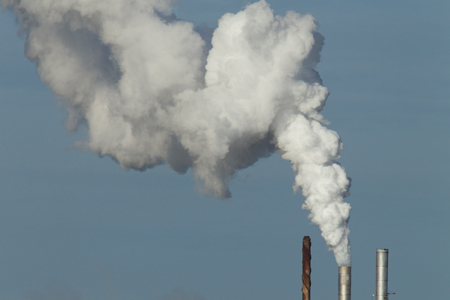
Hanford Facility, Washington
In my last article on the nuclear issue, "Our Nuclear Future, Financial Risk and Externalities",
I discussed Rating Agency Capital Models in the context of nuclear risks such as those posed at Fukushima, Chernobyl and Three Mile Island.
The issue of managing the risks associated with both military and commercial nuclear applications is a vital one, that should interest all of us and speaks to the very concept of externalities and how to manage them in a global world. In this article I focus on commercial applications.
The Fukushima disaster was impacted by inadequate safeguards. The tsunami risk was not adequately taken into account in planning where to place the back up generators which could restore power in the event of an interruption of power. The back up generators were placed at point too near the sea wall protection that left them exposed to the tidal wave action of the large tsunami that hit off Fukushima on March 11, 2011, when an 8.9 magnitude earthquake was experienced.
How do we deal with the risk management issues concerning the financing, construction and operation of nuclear plants, and with the issue of managing nuclear waste from both military and civilian applications? These issues concern low probability, high risk events, issues that fall outside of the scope of normal everyday events.
The federal government offers nuclear power plants some degree of protection from liability. These limits on liability, which exist in order to encourage the construction and operation of nuclear plants for power generation purposes, do not do as thorough a job of mitigating risk as they should. This is because an external party, the federal government, is responsible for the oversight. In the case of Fukushima, where plants are constructed and operated across national boundaries, the issues become more complex.
The Fukushima Daiichi nuclear power plant was constructed and operated in Japan, by Fukushima General Electric (GE), Boise, and Tokyo Electric Power Company (TEPCO). The components of the nuclear plant were provided by contractors such as GE,which provided six GE nuclear reactors. Other contractors were also involved. Multi-national resources were employed. Liability issues are very difficult to ascertain. It is very probable that the loss of the ability of the generators to provide power after interruption in service due to the tsunami materially impacted the fate of the nuclear material in those reactors and magnified the effect of the event.
Management of these issues across national boundaries presents a serious issue. How do you price for risk when governments put caps on liabilities? It is easier for companies to price for risk when the risk is limited! The incentive for commercial entities to manage risk is reduced when they do not have to absorb the risk of extreme events in either pricing of their products, mitigation of that risk, or the application of design elements to manage that risk. The risk is shifted to the governments.
When all else fails, due to the failure to put in place elements that will mitigate extreme risk, governments have to step in. At this point, governments must ascertain their own issues of financial accountability and debate among themselves. This issue is currently unfolding as nuclear radiation emerges from the Fukushima disaster and manifests itself in the ocean, carried by currents, and in the air, as was the case with the Chernobyl event.
Clearly, there must be a better match between potential liabilities and mitigation of risk. The problem occurs when it becomes financially unfeasible for companies to price for the risk of very low probability, high risk externalities. The government(s) must retain the capability to regulate. History has shown that government regulation is difficult in the face of corporate profits. This was shown in the history of seeking to regulate the ASARCO smelter.
Nuclear power plants do not arise ex nihilo. They must be financed, built, insured. How do you finance nuclear power plants? They can be built with government financing and the government can assume all the risk. In a commercial enterprise, across national boundaries, private parties can finance nuclear power plants if they have sufficient funds and can insure the risk of loss, either by commercial carriers, government support or by self insuring.
There are many financial instruments that may be available to finance nuclear power plants. In addition, nuclear power plants require real estate. A component of a nuclear power plant can conceivably be moved from one site to another, yet the ground below stays, and is subject to the risk of contamination.
It is instructive to look back at the history of Nuclear Power Plant generation in the Northwest. The situation with Washington Public Power Supply System Bonds is instructive (WPPSS). An article from HistoryLink.org discusses this history of one of the largest bond defaults in history. Five WPPSS power plants were envisioned, and WPPSS power plant 2, the Columbia Generating Station, survives. The facility is now called Energy Northwest, and produces 12% of the power generated by the Bonneville Power Administration.
A great portion of the Northwest's power supply is generated by hydroelectric sources such as those operating along the Columbia River.
The discussion of financing nuclear power plants rests with a projection of bond default experience over time (default matrices), and how bond ratings emerge through Rating Agency models such as Standard and Poor's, Moody's and A.M. Best.
Clearly, the issue of using bonds to finance nuclear power plants is a critical one, in more than one way. WPPSS financing has provided an example of the risk of building nuclear plants, financing them, and having companies such as insurers and banks assume the risk of financing them.
Financial institutions take risks when they purchase company bonds. The construction and operational risks (there are separate bonds for construction and operation) are borne by those that purchase the bonds. Riskier enterprises are assigned a risk premium that is reflected in the interest rate offered on the bond. The riskier the enterprise, the higher the interest rate, and the longer it takes the enterprise to retire the bond. This is basic economics.
Given the history of WPPSS, it is difficult to construct a model for financing nuclear power plant construction. History has shown that even rating bonds for more ordinary applications, is fraught with risk. The financial events of 2008 have demonstrated to us how the domino effects of certain companies being taken down can bring a financial system to the brink. It is clear that certain financial institutions were allowed fail, while others were bailed out by the government. Insurer AIG, for example, was bailed out, while Washington Mutual was allowed to fail. This is a very interesting aspect to investigate, since Chase was left purchasing and holding the assets that Washington Mutual had accumulated over time.
The 2008 financial collapse is another blog article, however it is instructional in how bond defaults can bring down a financial system. Suffice it to say that mortgage backed securities, collateralized mortgage obligations, credit default swaps (CDS's) and collateralized debt obligations (CDO's) played a large role in this collapse. These issues reflected the financial arbitrage reflected in Rating Agency and regulatory agency capital analysis of financial institutions. The actions that the government took, in deciding which institutions to rescue and which institutions to allow to fail, helped determine the path that would be taken.
Rating Agencies played a large role in the events that unfolded. I have discussed Rating Agencies in previous articles.
Clearly, nuclear financing issues present complexities beyond those presented by other issues financed by our market system. There are limits to liability that impact the nuclear arena. We are left, then, with a cooperative issue impacting the ways in which governmental regulatory agencies can interject themselves into the system and regulate in a manner to mitigate low probability high impact risk.
This takes us again back to the past, and the issues attendant in regulating ASARCO Smelter Emissions and the problems that this issue presented.
These are the issues we face in these times of global warming and climate change, as we consider the risks and benefits of financing nuclear power plants. Alternative energy sources are discussed in my article "Global Warming and Climate Change - Polar Pioneer" .
We must consider the issues of regulatory government as it is juxtaposed with issues concerning market operations, in dealing with situations that involve low probability, high risk events. It is clear that unfettered market operations may bring about market collapse through the interrelationships that exist within the structure of markets. It is also clear that government regulation that is not strong enough may not be able to counter the impact of market forces that overrun it, especially considering the profits that can be developed in certain markets. Furthermore, it is clear that government forces may act in a manner contradictory to public interest by choosing winners and loser, perhaps steered by an array of predefined values of certain groups.
Can we trust government? We must have checks and balances. Do we want government to only have one option, or to offer choices? I'm in favor of choices, as choices facilitate change, which is needed. Market research has shown that people can tolerate only so many choices; this has been in areas such as bottled peaches, cereal, etc. Would we ever want our choices in cereals and bottled peaches to govern our choices in power generation and other key areas? No, however the analogy is instructive.
We need a government strong enough to regulate; the problem in regulation, however, has shown that it is difficult for regulatory agencies to keep up with the profits that can be made from activities under investigation. This is certainly true in the financial arena where new instruments, especially those employing financial arbitrage, arise in order to present profit opportunities that defy regulation.
Constitutional issues such as due process and informed consent are bell weather issues in our financial and social system. The Justice Department has a long storied history in regulating monopoly. These are all important issues as we consider regulation of markets, intrusion of regulators/law enforcement into markets, and imposition of systems which defy Constitutional rights.
These issues all reflect ongoing issues of climate change and global warming and the effect of the environment on certain populations.
Our Constitutional rights are now under attack and must be defended, especially as regards issues of due process and informed consent. I have made a thorough examination of the social processes existing in our society today and find material flaws in social systems.
Social systems and the justice system as they currently exist need serious reforms to enforce the Constitutional rights that we hold so dear to us, as do imposed belief systems.
How do we deal with the risk management issues concerning the financing, construction and operation of nuclear plants, and with the issue of managing nuclear waste from both military and civilian applications? These issues concern low probability, high risk events, issues that fall outside of the scope of normal everyday events.
The federal government offers nuclear power plants some degree of protection from liability. These limits on liability, which exist in order to encourage the construction and operation of nuclear plants for power generation purposes, do not do as thorough a job of mitigating risk as they should. This is because an external party, the federal government, is responsible for the oversight. In the case of Fukushima, where plants are constructed and operated across national boundaries, the issues become more complex.
The Fukushima Daiichi nuclear power plant was constructed and operated in Japan, by Fukushima General Electric (GE), Boise, and Tokyo Electric Power Company (TEPCO). The components of the nuclear plant were provided by contractors such as GE,which provided six GE nuclear reactors. Other contractors were also involved. Multi-national resources were employed. Liability issues are very difficult to ascertain. It is very probable that the loss of the ability of the generators to provide power after interruption in service due to the tsunami materially impacted the fate of the nuclear material in those reactors and magnified the effect of the event.
Management of these issues across national boundaries presents a serious issue. How do you price for risk when governments put caps on liabilities? It is easier for companies to price for risk when the risk is limited! The incentive for commercial entities to manage risk is reduced when they do not have to absorb the risk of extreme events in either pricing of their products, mitigation of that risk, or the application of design elements to manage that risk. The risk is shifted to the governments.
When all else fails, due to the failure to put in place elements that will mitigate extreme risk, governments have to step in. At this point, governments must ascertain their own issues of financial accountability and debate among themselves. This issue is currently unfolding as nuclear radiation emerges from the Fukushima disaster and manifests itself in the ocean, carried by currents, and in the air, as was the case with the Chernobyl event.
Clearly, there must be a better match between potential liabilities and mitigation of risk. The problem occurs when it becomes financially unfeasible for companies to price for the risk of very low probability, high risk externalities. The government(s) must retain the capability to regulate. History has shown that government regulation is difficult in the face of corporate profits. This was shown in the history of seeking to regulate the ASARCO smelter.
Nuclear power plants do not arise ex nihilo. They must be financed, built, insured. How do you finance nuclear power plants? They can be built with government financing and the government can assume all the risk. In a commercial enterprise, across national boundaries, private parties can finance nuclear power plants if they have sufficient funds and can insure the risk of loss, either by commercial carriers, government support or by self insuring.
There are many financial instruments that may be available to finance nuclear power plants. In addition, nuclear power plants require real estate. A component of a nuclear power plant can conceivably be moved from one site to another, yet the ground below stays, and is subject to the risk of contamination.
It is instructive to look back at the history of Nuclear Power Plant generation in the Northwest. The situation with Washington Public Power Supply System Bonds is instructive (WPPSS). An article from HistoryLink.org discusses this history of one of the largest bond defaults in history. Five WPPSS power plants were envisioned, and WPPSS power plant 2, the Columbia Generating Station, survives. The facility is now called Energy Northwest, and produces 12% of the power generated by the Bonneville Power Administration.
A great portion of the Northwest's power supply is generated by hydroelectric sources such as those operating along the Columbia River.
The discussion of financing nuclear power plants rests with a projection of bond default experience over time (default matrices), and how bond ratings emerge through Rating Agency models such as Standard and Poor's, Moody's and A.M. Best.
Clearly, the issue of using bonds to finance nuclear power plants is a critical one, in more than one way. WPPSS financing has provided an example of the risk of building nuclear plants, financing them, and having companies such as insurers and banks assume the risk of financing them.
Financial institutions take risks when they purchase company bonds. The construction and operational risks (there are separate bonds for construction and operation) are borne by those that purchase the bonds. Riskier enterprises are assigned a risk premium that is reflected in the interest rate offered on the bond. The riskier the enterprise, the higher the interest rate, and the longer it takes the enterprise to retire the bond. This is basic economics.
Given the history of WPPSS, it is difficult to construct a model for financing nuclear power plant construction. History has shown that even rating bonds for more ordinary applications, is fraught with risk. The financial events of 2008 have demonstrated to us how the domino effects of certain companies being taken down can bring a financial system to the brink. It is clear that certain financial institutions were allowed fail, while others were bailed out by the government. Insurer AIG, for example, was bailed out, while Washington Mutual was allowed to fail. This is a very interesting aspect to investigate, since Chase was left purchasing and holding the assets that Washington Mutual had accumulated over time.
The 2008 financial collapse is another blog article, however it is instructional in how bond defaults can bring down a financial system. Suffice it to say that mortgage backed securities, collateralized mortgage obligations, credit default swaps (CDS's) and collateralized debt obligations (CDO's) played a large role in this collapse. These issues reflected the financial arbitrage reflected in Rating Agency and regulatory agency capital analysis of financial institutions. The actions that the government took, in deciding which institutions to rescue and which institutions to allow to fail, helped determine the path that would be taken.
Rating Agencies played a large role in the events that unfolded. I have discussed Rating Agencies in previous articles.
Clearly, nuclear financing issues present complexities beyond those presented by other issues financed by our market system. There are limits to liability that impact the nuclear arena. We are left, then, with a cooperative issue impacting the ways in which governmental regulatory agencies can interject themselves into the system and regulate in a manner to mitigate low probability high impact risk.
This takes us again back to the past, and the issues attendant in regulating ASARCO Smelter Emissions and the problems that this issue presented.
These are the issues we face in these times of global warming and climate change, as we consider the risks and benefits of financing nuclear power plants. Alternative energy sources are discussed in my article "Global Warming and Climate Change - Polar Pioneer" .
We must consider the issues of regulatory government as it is juxtaposed with issues concerning market operations, in dealing with situations that involve low probability, high risk events. It is clear that unfettered market operations may bring about market collapse through the interrelationships that exist within the structure of markets. It is also clear that government regulation that is not strong enough may not be able to counter the impact of market forces that overrun it, especially considering the profits that can be developed in certain markets. Furthermore, it is clear that government forces may act in a manner contradictory to public interest by choosing winners and loser, perhaps steered by an array of predefined values of certain groups.
Can we trust government? We must have checks and balances. Do we want government to only have one option, or to offer choices? I'm in favor of choices, as choices facilitate change, which is needed. Market research has shown that people can tolerate only so many choices; this has been in areas such as bottled peaches, cereal, etc. Would we ever want our choices in cereals and bottled peaches to govern our choices in power generation and other key areas? No, however the analogy is instructive.
We need a government strong enough to regulate; the problem in regulation, however, has shown that it is difficult for regulatory agencies to keep up with the profits that can be made from activities under investigation. This is certainly true in the financial arena where new instruments, especially those employing financial arbitrage, arise in order to present profit opportunities that defy regulation.
Constitutional issues such as due process and informed consent are bell weather issues in our financial and social system. The Justice Department has a long storied history in regulating monopoly. These are all important issues as we consider regulation of markets, intrusion of regulators/law enforcement into markets, and imposition of systems which defy Constitutional rights.
These issues all reflect ongoing issues of climate change and global warming and the effect of the environment on certain populations.
Our Constitutional rights are now under attack and must be defended, especially as regards issues of due process and informed consent. I have made a thorough examination of the social processes existing in our society today and find material flaws in social systems.
Social systems and the justice system as they currently exist need serious reforms to enforce the Constitutional rights that we hold so dear to us, as do imposed belief systems.
Our Nuclear Future - Financial Risk and Externalities
Our Nuclear Future - Hanford and Spent Nuclear Fuel
Global Warming and Climate Change - "Polar Pioneer" and Arctic Drilling
Chernobyl 25th anniversary
Energy Choices and Risk
Global Warming and Climate Change-Polar Pioneer
Processing Risk and Uncertainty
Log in the Surf - 8.9 Japan Earthquake (9.0 updated)
History Link.org
Washington Public Power Supply System