Mt Rainier

Mt Rainier
Mt Rainier
Showing posts with label Antarctica. Show all posts

Friday, August 7, 2015

Financial Rating Agencies and Risk - Liquidity

Iceberg, Weddell Sea, Antarctica

Updated 9/5/2015:
 
I took this photograph from the Icebreaker Kapitan Khlebnikov, as we transited the Weddell Sea from the Ice Shelf of Halley Bay to the Antarctic Peninsula.  Antarctica (map) is a land of beautiful desolation, and I was able to capture nature photographs depicting its stunning landscapes and the wildlife that inhabits it.  Many countries have stations in Antarctica and I was honored to be able to visit two of them, Neumeyer (German) and Halley Bay (United Kingdom).  

Icebergs have powerful symbolism, expressing concept in many different venues.  In the maritime sense, they represent hidden risk, as ten percent of the iceberg may be visible, the remaining ninety percent of the iceberg underwater.  The Titanic collided with an iceberg in the mid-Atlantic in 1912 and is an example of risk associated with transiting areas with icebergs.  These powerful metaphors or concepts can also be expressed in other venues, including the financial arena, where risk exists and may be hidden, subject to the impact of financial bifurcation points.  

Chaos theory discusses how financial risk, and bifurcation points can reflect hidden factors which sudden express what we term "Black Swan" risk events as typified by Mohamed A. El-Erian's work.

In the financial arena, these risks reside in financial rating models.  My June, 2015 article, Financial Rating Agencies and Risk, discusses Rating Agency models in the context of jet engines, which operate under a wide range of atmospheric conditions. Similarly, financial vehicles are tested under a wide range of scenarios, by various entities such as Rating Agencies and regulators in a wide variety of fields, including banking and insurance, under different legal constructs and governmental agencies.

As discussed in my article, Financial Rating Agencies and Risk, different Rating Agencies, such as Standard and Poor's and Moody's may reflect their analysis of risk in different ways.  General Electric (GE) is used as an example in my blog article. which discussed Standard and Poor's maintenance of GE's rating in the light of its decision to divest itself of real estate assets and exit its GE Capital Finance arm.  Moody's, however, downgraded GE on its decision, indicating GE was favoring equity investors over creditors.  These rating decisions reflect different decision processes by Rating Agencies, not explicit government agencies.  However these Rating Agencies have considerable impact over the manner in which financial decisions are reflected in the marketplace.

Clearly, there is hidden information which Rating Agencies, and governmental entities, are aware of.  When there is a relationship between Rating Agencies and financial entities, as in the payment of a fee in exchange for a rating service, there is an incentive for the Rating Agency to monitor the actions of the company, as money has changed hands, and participate in the decisions of the company involved.. At some point, however, the economic prospects of the company do not warrant the degree of risk assigned to it, and the Rating Agency may choose to exercise a number of financial tools in order to maintain its credibility in the financial marketplace as a reliable partner in assessing risk.

You see, the Rating Agency has two major clients; one, those purchasing its evaluations of companies, and another, two who pay for its services in order to exchange information, maintain a rating as to its financial soundness, and exchange information in order to do so.  Government agencies are a different entity involved, and they sit and cast a watchful eye over the ability of Rating Agencies to remain impartial; they are also concerned as to the ability that Rating Agencies have to move the markets, and, especially, their ability to impact major market moves that could mask efforts at financial or other types of terrorism.

This is where the increased complexity of emerging financial instruments presents a risk for regulators as they seek to keep up with new financial structures and derivatives such as special purpose vehicles, credit default swaps (CDS) and collateralized debt obligations (CDO's).  The Treasury, certainly, is interested in attack on the financial system.

A company does not exist in a vacuum; it exists within a financial structure of ever increasing complexity, reflecting not only national considerations, but a world economic milieu of globalization that impacts its decisions, as nations develop and industries expand, contract and relocate or adopt new methodologies such as outsourcing.  Externalities are always a consideration, and this this issue is discussed in my blog article of the same name.

This brings us back to the iceberg and the hidden factors. GE presents an interesting case study as we look to parse the actions of Standard and Poor's and Moody's in their rating of GE.  My blog article, Our Nuclear Future - Financial Risk and Externalities briefly discusses the issue of the six nuclear plants designed by GE, which were part of the Fukushima Daiichi Nuclear Site's design.  The interesting question is the use of ratings in conjunction with the use of chaos theory and bifurcation points to bring down the economy and financial system.

There are specific provisions (options) in financial agreements that allow a company to take action in the case of certain events such as ratings downgrades.  This puts a particular onus on Rating Agencies who have access to company information; it also presents a challenge to companies being rated as they seek to understand the processes which rating agencies use to rate their companies.

The interesting question in analyzing GE in the light of its departure from GE Capital, which finances GE engines, and from real estate, is its liquidity position and its exposure to risk from liquidity events in the light of the various risks that its operations faces.

Indeed, liquidity is an important consideration in analyzing a company's financial soundness.  An example where liquidity events have taken down companies is General American Insurance, where exposure to risk from institutional investors brought down the company.  General American had high exposure to funding agreements, which allowed policyholders to exercise a put option (withdraw funds without penalty) upon the adverse action of Rating Agencies. The construction of funding agreements involved mark to market issues and the use of put options in mutual funds (7 day put options).  Moody's downgraded General American's insurance financial strength rating from A3 to Ba1 on August 9, 1999.

The interesting question with the actions of Standard and Poor's and Moody's with regards to GE is the divestiture of the GE Capital financing arm and the Real Estate assets; both of these events seem to reflect a move to better match projected assets and liabilities by increasing liquidity, potentially in the light of anticipated liabilities.  These are the hidden, or unknown issues that confront regulators.

Why discuss GE?  With issues of climate change and global warming, jet engines, which operate under a wide range of atmospheric conditions utilize various fuels for combustion under a wide degree of parameters representing different aspects of aviation usages, including private, commercial and government use. My blog article on the Polar Pioneer discusses these issues in the light of exploration and drilling for petroleum products in the Arctic. The availability of fuel and the mode of combustion and types of engines employed will always be an important characteristic of any decision process as we analyze our future options.

Many people have contributed to the issues discussed in these blog articles and I express my appreciation to them and to their contributions.

Liquidity issues are important factors in assessing financial risk.  They represent one category of risk among others that can reflect bifurcation points which can impact the economy.  Organization structure is also important, as indicated by the Barings Bank issue where Nick Leeson was involved on both sides of the house, trading and operations.

Alamy.com - Risk Lightbox

marilyndunstan.blogspot.com:

Wikipedia:

Maps:

Rating Agencies:


General American Insurance:

GE:


Saturday, February 21, 2015

Climate Change and Carbon


Global Warming and Climate change are important topics.  Recent talks at the United Nations have highlighted the concern about these planetary issues that go beyond borders and seek to unite people in discovering means to solve the emerging problems.

The United Nations climate change site indicates that 2014 is on track to being among the hottest on record.  Christiana Figueres, Executive Secretary of the UN Framework Convention on Climate Change states "Fortunately our political climate is changing too with evidence that governments, supported by investors, business and cities are moving towards a meaningful, universal climate agreement in Paris 2015 - an agreement that keeps a global temperature rise below 2 degrees C by putting in place the pathways to a deep de-carbonisation of the world's economy and climate neutrality or 'net zero' in the second half of the century."

A recent article in Scientific American discusses United Nations climate talks in Paris last December. As the article indicates "(The planet's surface has warmed about 0.85 degrees C (1.5 degrees F) since 1880, worsening floods, storms and deadly heat waves.) The 2 degrees C target has since become a keystone goal of the negotiations."

NASA's, Global Climate Change: Vital Signs of the Planet displays information about climate change. including graphs and latest measurements.  This information shows steadily increasing recorded carbon dioxide levels in recent history, with inputed history obtained from ice cores indicating significant variation from historical levels over three glaciation periods. Ice cores have been drawn from the Arctic, Antarctic and mountain glaciers.  The measured value as of January 2015 showed 399.73 parts per million (ppm), just under 400 ppm. At current rates it should exceed 400 ppm in February 2015.


 NASA's Climate Change site provides information on Global Temperature.  Five year averages in global temperature are measured relative to a 1951-1980 average temperature baseline, indicating a dip in global temperature around 1910 and a steady rise since then.

Global Warming concerns have fostered considerable research  on climate change issues, seeking ways to mitigate the impacts of climate change, providing potential solutions.  Climate change and environmental issues have been addressed at local, state, federal and international levels.   The CIA World Factbook provides a list of Current Environmental issues and international agreements which countries listed are a "party to" and/or "signed, but not ratified".

I discuss some of the issues relating to climate change, including global health in other blog articles relating to Climate Change and Global Health  and Avian Flu.

Carbon, and especially carbon dioxide are sequestered in a number of areas on the planet, including in the rocks and in the oceans.  Other greenhouse gases, such as methane, are sequestered in areas such as Arctic Tundra, and in the oceans.  The questions remain as to how much capacity does our planet have to sequester carbon, without over stressing the resource with storage demands and whether there is a risk that carbon which has been already sequestered might be released back into the environment.

An outgassing of carbon dioxide at Lake Nyos (1986), in Africa, illustrates the problem which can occur with a body of water that is saturated with carbon dioxide.  Lake Nyos lies above a pocket of magma and is one of only three lakes saturated with carbon dioxide.  Lake Nyos is not the size of the ocean, however.

It is clear that carbon, and carbon dioxide are keystone issues in addressing global warming and climate change.  Global warming is especially sensitive to changes in carbon dioxide, as increases in carbon dioxide can also lead to increases in water vapor in the atmosphere, as indicated by a NASA report. Water vapor is the most abundant greenhouse gas.  Thus, increases in carbon dioxide in the atmosphere can act in a positive feedback manner to increase the greenhouse effect.

Just as carbon dioxide is a sensitive indicator in the atmosphere, and may represent a bifurcation between different climatological paradigms, one pursues, seeks and finds answers as to the equivalent impact that changing carbon dioxide atmospheric concentrations have on the human body, which is also a sensitive indicator of climate change. These findings have implications for Global Health, as well the psychosocial milieu in which mankind experiences climate change.

These are all very serious issues worthy of further research, consideration and action. The key question is the manner in which homeostasis is achieved, given the climate change issues.


Thursday, April 21, 2011

Emperor Penguin Energy-Risk Model - Part 2


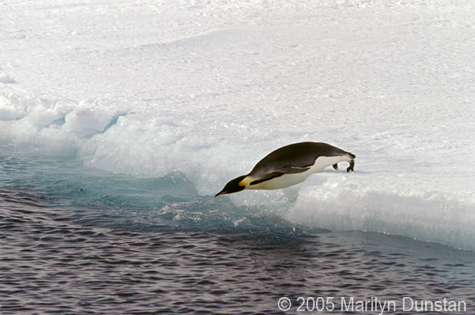
Emperor Penguin Diving onto Ice Shelf from Sea, Stancomb Wells Ice Edge, Weddell Sea, Antarctica (Image on Alamy.com)

In my last blog post “An Emperor Penguin Energy-Risk Model” on April 14, 2011, l discussed the predator-prey relationship between the leopard seal and emperor penguin in Antarctica. The leopard seal waits at the edge of the ice shelf and opportunistically picks off emperor penguins entering or leaving the sea. For the emperor penguin, feeding at sea is a decision between the need to feed to live and the risk of dying in the mouth of a leopard seal..

In the blog post I state: “From studying the emperor penguin and the leopard seal we know the emperor penguins will continue to feed, but so will the leopard seal. Some emperor penguins, despite their various risk protection strategies, will get eaten. It is important to note that in a probabalistic sense, we know that some penguins will be eaten by the leopard seal, but we don’t know which specific penguins will “bite the dust”.” This is true casually looking at a row of emperor penguins lined up to go into the sea in search of food.

However, upon closer analysis and study, over a period of time, it might be possible to determine which emperor penguins have a bit of catch in their step, have been injured in a narrow escape from a leopard seal, or have slowed down. These emperor penguins might come a belly-flop short of landing on the ice, and end up as prey in the mouth of a leopard seal. However, it is also possible, that a healthy, fit, member of the emperor penguin colony might suffer a particularly ill-fated episode of bad luck. This penguin might be in the wrong place at the wrong time when the leopard seal is rising out of the water with its mouth wide open ready for business. In fact, you could have the emperor penguin equivalent of the 4.0-40 yard dash champion, and end up as leopard seal “dinner”, with some bad luck and timing.

Looking at emperor penguin energy-seeking behavior and risk, it becomes apparent that probabilities have a great deal to do with the outcome but are not deterministic. You may attach a relatively higher probability of being eaten to the more fragile members of the emperor penguin population and a relatively lower probability of being eaten to those fitter members. The larger the colony size, and the more emperor penguins entering the sea at the same time, the lower the risk, the probability of being eaten, for any particular emperor penguin as there are more penguins entering the sea. (“there’s safety in numbers”).

You can run scenarios with differing proportions of fragile and fit emperor penguins, with higher and lower probabilities of being eaten (mortality rates), varying degrees of illness (morbidity rates) or accident, including leopard seal attack. In such scenarios, the leopard seal would most likely pick off different emperor penguins each time the scenario is run, however there would be objective tendencies to pick off more members of the more fragile group versus those of the fitter group.

In performing mathematical modeling of the fate of the emperor penguins by running scenarios with objective data and assumptions, we may set up a stochastic process which helps us to understand the behavior of the system as it evolves under a variety of scenarios.

Mathematical models involve expressing real world problems in mathematical language. This entails defining variables and establishing a formulaic process which will express the model as evolves. Variables are elements in the model which may change during the model. Because they may change, the model needs to calculate how they change over the course of the model and how they interact with other model variables, and are affected by the constants assumed by the model. Constants may arise from established data or may be assumptions plugged in to the model.

Stochastic processes incorporate non-deterministic, random elements into a mathematical model. The result may vary with time and with each model run. In comparison, a deterministic model will always produce the same result given the same assumptions and initial state. Thus, a stochastic process is run using random processes, employing a variety of assumptions and probability distributions informing objective tendencies for various model events to occur..

The random process in stochastic modeling will randomly choose which penguins are attacked, survive, suffer morbidity or injury from accident, and die over a period of time. Each run will be unique, as specific, members of the colony are differently impacted by the random process each time. By running many such models, one can get a picture of the survival data for the colony as a whole under a wide range of assumptions. Depending on the characteristics of the data, model and variables, results may be similar on an overall group basis, while differing by individual members impacted over time.

Under a normal range of assumptions and outcomes, this model may well predict overall group behavior over a period time. However modeling becomes much challenging when very low probability events enter into the model or rear their head in actual life.

For example, a eruption of an Antarctic volcano may be infrequent, however it could certainly impact emperor penguins. If the model assumed a volcanic eruption with a low probability, a robust number of stochastic model runs may randomly select such an event resulting in a BBQ penguin supper for the leopard seals.

The objective of the stochastic processes is to help us inform our decision making process, to help us understand the impact of variables under a wide range of assumptions, conditions, and scenarios. Thus a stochastic process should inform us about the expectations of the model under a wide variety of conditions, including the impacts of low probability / high risk events.

Thursday, April 14, 2011

An Emperor Penguin Energy-Risk Model


Emperor Penguin Preparing to Dive off Riiser-Larsen Ice Shelf (Image on Alamy)

The emperor penguin (aptenodytes fosteri) is the largest of the penguin species and lives in Antarctica in large colonies. Emperor penguins live in the harshest of climates in Antarctica, where the temperatures can get down to 40 degrees Fahrenheit and with strong winds up to 89 mph, developing a sizable wind chill factor. The penguin breeding colony stays together during the harsh winter, constantly churning the boundaries of the colony, sustaining the group.

The female emperor penguin lays one egg, which is nurtured by the male while the female returns to sea to fish. The male will then nurture the young chick in his brood pouch. Later, both parents take turns hiking to the ice shore, diving into the Antarctic waters, in search of food. Fish and crustaceans such as krill provide sustenance for the penguin, energy to keep it going.

This source of penguin energy is available from “the deep”. Lots of krill. Lots of fish. Lots of energy to power penguins. One catch. A predator. The leopard seal (Hydrurga leptonyx). The leopard seal is a large mammal (between 400 and 1300 pounds) that attacks the emperor penguin, often at the edge of the ice where it can make opportunistic kills. This video by BBC Earth shows the interaction between a leopard seal and emperor penguins.


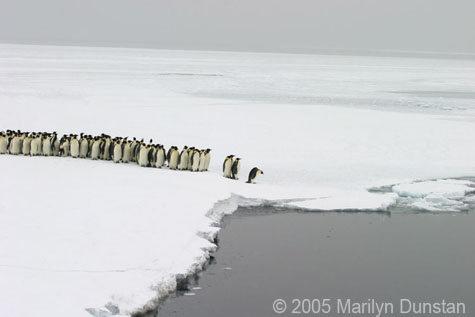
Emperor Penguins Lining up to Dive into water at Halley Bay Ice Edge (Image on Alamy)

A decision by an emperor penguin to dive into the water at ice’s edge is a decision to face a risk of being killed by the leopard seal or starve. Emperor penguins will accumulate in a line at the edge of the ice, waiting to take off, en-masse, into the water to feed. A tipping point is reached at some point where the shared risk of the group warrants all exiting off the ice edge into the cold deep, in quick succession. Feeding takes place in the open water and the emperor penguins quickly launch themselves through the air as they exit the water to land on the ice edge. They are playing the odds.

The emperor penguin’s appearance manages its risk to a certain extent. The emperor penguin’s black and white exterior helps to mitigate risk. The penguin’s black back appears lost looking downward against the black background of the marine deep. Looking upward from below, the emperor penguin’s white belly may be lost in the white glare of the water surface. This provides some degree of camouflage.

The penguins’ group decision, so neatly balanced in their emperor penguin-risk-matrix minds conceptually captures the “weighing of risks” issue as regards satisfying their energy needs. The penguin needs to take risks in order to eat, to supply energy, in order to live.

Food, after all, supplies energy that keeps us in business just as the various types of fossil fuels, nuclear energy and alternative energy sources provide energy for us to meet our various needs.

Our planet seems to shrink around us with population growth, economic development, energy demand and climate change challenges. As we seek to manage our lifestyles in this challenging environment, we are not unlike the emperor penguin. We face risk in pursuing our energy wants and needs.

We can analyze the risk patterns associated with the various energy choices that we have. These risk patterns vary considerably depending on which mix of energy resources are employed.

From studying the emperor penguin and the leopard seal we know the emperor penguins will continue to feed, but so will the leopard seal. Some emperor penguins, despite their various risk protection strategies, will get eaten. It is important to note that in probabalistic sense, that we know that some penguins will be eaten by the leopard seal, but we don’t know which specific penguins will “bite the dust”.

Similarly, as we explore various energy choices, we need to study the associated risks. We need to anticipate risks that may happen and proactively build defenses against them. However, we are kidding ourselves if we think that we can forever eliminate all such risks. It is the nature of evolving life to defeat such a worthy goal, as accidents can happen. It may be possible to predict the fact that accidents may happen while at the same time not being able to pinpoint exactly where or when they may occur. This consideration lends itself to a more global view of risk management, rather than focusing on any one particular potentiality.

In considering the risks associated with expanding energy sources to meet demand, its also appropriate to bring up ways to reduce energy demand, to become more efficient, to do more with what we have. This option becomes more attractive as the costs of the alternative options increases.

Thursday, December 31, 2009

Exploration - New Year's Eve Posting


Riser-Larsen Ice Shelf, Antarctica


The concept of exploration is a compelling one. As children we explore our neighborhood to find new treasures. As adults we explore new destinations and experiences. Venturing into the unknown gives us a sense of both eager anticipation and risk as we explore harsh environments such as Antarctica. The act of surmounting those risks fulfills us and we return home to tell our story, ready to take on new challenges.

As we enter into the New Year 2010 we can reflect upon the exploration of Space, the contributions of those working in Space programs, and the astronauts who work there.

NASA’s website discusses exploration initiatives, and includes discussion on history, motivation for space travel and other areas.

The Museum of Flight in Seattle has an excellent display of Space-related exhibits that educate and inspire.

Humanity has an opportunity to reach for the stars, to make dreams and imagination come alive.

The stars have long been a source of dreams and visions, expressed in both non-fiction and fiction form. The Arthur C. Clarke novel “2010: Odyssey Two” which was also made into a movie, expresses a shared human sentiment for space exploration and the conquering of the unknown.