Mt Rainier

Mt Rainier
Mt Rainier

Saturday, May 21, 2011

Calculating Odds and Probabilities


1986 Liberty Half Dollar Tossed on Grass (Heads) (Image on Photoshelter)


A team will have an opportunity to call “heads or tails” for a coin toss at the beginning of a football game. If the call is successful, heads in the case of the coin pictured above, the team will have the opportunity to chose to take the ball (go on offense) or defend a particular goal. The choices are non-trivial as a team’s defense may be superior to their offense, or the wind may determine the choice of the goal defended. These choices represent the team’s expectations of their success, given their strengths, weaknesses and prevailing conditions.

The coin toss, for a fair coin, will give a probability (p) of .5, or 50% that the call (either heads or tails) will be successful. Coins flipped successively will tend, over a period of time to “revert to the mean”, or tend towards their expected value of 50% heads and 50% tails. The odds ratio for the coin toss is 1:1. Odds ratio is calcuated as the ratio of the probability of the event happening (p) to the probability that it won’t happen (1-p). Thus, out of 2 possible outcomes (heads or tails), one outcome (out of 2) is successful, one outcome (out of 2) is unsuccessful, for a ratio of 1:1.

While the coin toss is random, there is a balance of risks involved in the result. For example, a team with a superior offense can choose to go on offense, sputter on three downs, punt, and turn the ball over to the other team in good field position, despite their expectation of offensive success.


Two Sixes Dice Toss (infrared digital effect) (image on Photoshelter)

People use probabilities and odd ratios in their daily lives, consciously and unconsciously computing expectations and making decisions based on those expectations.

Some may choose to gamble on the roll of the dice. In this case, the probability of rolling two sixes is (1/36) while the odds are 1 to 35 (1 good outcome, 35 losing outcomes). When gambling in an establishment, the house will include a margin in for themselves, to cover expenses and profit. Given fair dice, the underlying odds (and the probabilities) will tend towards their mathematical expected value (1 to 35 and 1/36), thus giving over time a margin to the house.

Mathematical models can calculate the odds that there will be a city rivalry World Series this year, the odds of a particular candidate winning the 2012 election, and many other events.

Of particular interest are the mathematical models that deal with environmental issues, such as weather and climate change, given the emergence of extreme weather events.

Albert Einstein was quoted as saying “I, at any rate, am convinced that He does not throw dice.” (paraphrased as “God does not play dice with the universe”). However Stephen Hawking is quoted as saying “So Einstein was wrong when he said, "God does not play dice." Consideration of black holes suggests, not only that God does play dice, but that he sometimes confuses us by throwing them where they can't be seen”.

The National Oceanographic and Atmospheric Administration (NOAA) has sophisticated climatological models which forecast the weather, and they are continually improving these models in order to provide the maximum amount of warning possible to the populace. Through their efforts, NOAA is seeking to minimize the amount of risk, and maximize the information provided, seeking the “load the dice” in the publics favor.

We rely on weather forecasts in our daily plans. Should we call off the company picnic with a 70% chance of thunderstorms? How about that outdoor wedding? Do you pack the rain slicker or umbrella or leave it behind? Governments and businesses rely on weather forecasts for their daily operations and long term plans. Seasonal hurricane forecasts are looked at with interest by many sectors in planning ahead into the coming hurricane season.


Two United States Coast Guard Cutters monitoring the Westport, Washington Bar entrance (image on Photoshelter)

Nowhere is the issue of balance of risks and weather forecasting more apparent than in the maritime arena. When is the storm predicted to arrive? Is there a confidence interval around that arrival time, as well as its expected intensity? Sailors will balance the risk of venturing out and making headway to their destination versus the risk that the weather will take an unexpected turn for the worse, making for difficult, or hazardous headway, or worse.

The United States Coast Guard (USCG) is a branch of the U.S. Armed forces and is charged with maritime safety, security and stewardship. In this image, the two Coast Guard Cutters are monitoring the closed Westport Bar / navigational entrance from the Pacific Ocean to Westport, Washington. The USCG monitors ongoing conditions and weather forecasts to decide whether or not to close the bar, thus managing safety for mariners. The United States Coast Guard, in its decision-making, relies on the concept of balance of risk, as it makes decisions that affect the public. The public, in turn, makes decisions using balance of risk as it relies on NOAA guidance, the actions of the Coast Guard, and other factors.

It is human nature to calculate probabilities, calculate odds, consciously or unconsciously assess balance of risks. We do so continuously in our daily lives and rely on others to help us do so. We need to expand that awareness to include the risks we face due to environmental changes, consider the balance of risks inherent in the evolving situation, and find a way to meet the considerable challenges head on.

Wednesday, May 18, 2011

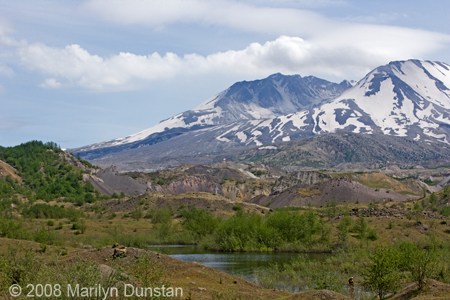
Mt St Helens 31st Anniversary of May 18, 1980 Eruption


Aerial View of Steam Eruption, Mt St Helens, May 20, 2006, taken from Johnston Ridge Observatory, Mt St Helens National Volcanic Monument, Washington (image on Photoshelter)

Thirty-one years ago, at 8:32 am on May 18, 1980, Mt St Helens erupted, in a cataclysmic eruption, that would change the face of the environment and sow the seeds of future renewal. Nature has its way of promoting renewal, through cycles of creation and destruction, and nowhere is this more evident than at Mt St Helens, where the volcano and environs continue to emerge in their new environment shaped by the vehicles of geological change.

Mt. St Helens National Monument can be reach from I-5 southbound at Toledo, SR 505, or from I-5 northbound at Castle Rock, SR 504 (Spirit Lake Highway). I took the latter route, visiting Washington State’s Silver Lake Visitor Center, 5 miles east along SR 504, and took in their presentation on the Mt St Helens Eruption “Cycle of Chaos and Creation”.

I entered Mt St Helens National Volcanic Monument, stopping at Hoffstadter Bluffs Visitor Center, enjoying a view of Mt St Helens in the distance and an excellent Elk Burger in their dining area before heading up to Johnston Ridge Observatory. As you drive towards Johnston Ridge Observatory, there are opportunities to pull over and enjoy differing views of the mountain as you get closer, including at the Elk Rock and Loowit Viewpoints.

The sense of closeness to the volcano becomes more than distance as you become more and more aware of the impact of the blast area on the landscape. Even as it is being transformed, being renewed, you are aware that there are thirty-one years of renewal, and that contrasts with the age of the landscape you left behind.


Mt St Helens Steam Eruption, May 20, 2006, viewed from Hummocks Trail showing renewal of vegetation, Mt St Helens National Volcanic Monument (image on Photoshelter)

The road heads downward before the last ascent to the Johnston Ridge Observatory. The Hummocks Trail provides an opportunity to hike amongst the hummocks, created by the Mt St Helens debris avalanche. The debris avalanche created by the eruption of Mt St Helens offered geologists an opportunity to learn about and identify such formations elsewhere.

From the Hummocks Trail, the road then climbs upwards towards Johnston Ridge Observatory at 4,255 feet. As you hike up an incline from the parking lot towards the Visitor Center, you are greeted with a marvelous view of Mt St Helens, looking right down into the throat of the volcano. It is up close and personal, looming as a reminder of the blast impact, as the crater opens up its giant maw to the visitor, you are struck by the awesome power that so forcefully reconstructed the landscape in the wake of its eruption.

As the clouds dance across the crater and the lava dome inside it, you are reminded that Mt St Helens, the youngest of Cascade volcanoes, has not been quiet since it’s May 18, 1980 eruption. Eruptive activity continued into 1986 and then resumed during 2004-2006, including dome building activity.

A visit to the Visitor Center gives the opportunity to explore exhibits, view a movie, “Message from the Mountain”, and attend ranger-guided talks. In one talk, the ranger used still photographs to illustrate various stages of Mt St Helens’s activity leading up to and including the eruption events. We saw Mt St Helens’s pre-eruptive recreational splendor as a near-perfect volcanic cone and glimpses of pre-eruptive awakenings.

As explained by the ranger, volcanic activity beneath the surface of the volcano eroded and weakened the rock structure on the side of the mountain, turning it to clay. This weakened area provided an opportunistic path for the upwelling magma to take, versus the hardened rock plug at the top of the volcano. The side of the mountain bulged with pressure and structural weakening. The landslide and accompanying 5.1 earthquake triggered the event that would unleash the power and fury of Mt St Helens, with resultant lateral blast, pyroclastic flows, lahars (mud flows) and an ejection of ash that would circle the globe.

It is sobering to realize that volcanism can eat away at a mountain’s rock structure from within, weakening it and exposing the mountain to risk of collapse. It is yet another example of a “tipping point” where a marginal change can have a result out of proportion to its own magnitude.

Geologists and volcanologists study volcanoes and other geological system and we are all continually learning from their experience. Johnston Ridge Observatory was named in memory of geologist David Johnston, volcanologist, who witnessed the May 18, 1980 eruption from what is now Johnston Ridge, and radioed in the message “Vancouver, Vancouver, this is it” before perishing in the blast.

The Mt St Helens 1980 eruption has resulted in a continued expansion in knowledge and monitoring tools for understanding the behavior of volcanoes.

In one study, the impacts of volcanic hydrothermal systems on Cascade volcanoes is being studied by the United States Geological Survey.

A wide range of information about Cascade Volcanoes can be found on the Cascade Volcano Observatory (CVO) site.

Tuesday, April 26, 2011

Chernobyl 25th Anniversary


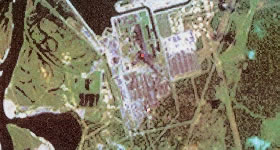
An aerial view of Chernobyl Nuclear Power Plant in April, 1986, with the red glow towards the center showing the heat from Unit #4. Source: epa.gov

The Chernobyl Disaster was a nuclear accident which occurred on April 26, 1986. It occurred in the Ukraine Republic (formerly part of the former USSR (Soviet Union)). Now the Chernobyl site is part of the country Ukraine. Today marks the 25th anniversary of the Chernobyl disaster.

It is particularly compelling to consider the impacts of Chernobyl today, twenty-fives years later, as we witness the unfolding of another nuclear disaster at Fukushima, Japan, following the 9.0 earthquake and tsunami on March 11, 2011. The two disasters arose from different circumstances and unfolded differently, however they share in common the impact of a low probability-high risk event.

They are set apart in both time and space, one occurring in vastness of the then-Soviet Union; the other set on the more densely populated island of Japan. The Chernobyl Disaster and the Fukushima disasters were both were graded as a 7 on the International Nuclear Event Scale. (Fukushima was raised from a 5 to a 7 on April 12, 2011, one month and a day following the earthquake and tsunami on March 11th).

How do we fathom such events as we seek to understand the risks of pursuing nuclear energy? How do we internalize these low probability-high risk events so that we carefully assess risks yet do not fall prey to unwarranted fears and suspicions? Do we hide our heads in the sands of improbability and ignore the potential of a very small yet very dangerous risk? Do we pour millions and billions of dollars to hedge against a risk that may never, in our lifetime occur? Do we even care about the impact of our decisions on those ancestors who may follow us many generations down the turnpike?

It is critical how we answer these questions, because our fate and the fate of our planet may hang in the balance. With the burgeoning population on this planet, the growing scarcity of resources, and the challenges presented by rising carbon dioxide levels, and other indications of planetary strain, we must find a way to make informed decisions that appropriately incorporate the low probability/high risk event in our search for and use of energy resources.

In my last blog posting, Emperor Penguin Energy-Risk Model - Part 2 , I discussed mathematical modeling, random variables and evolved a stochastic model of emperor penguin energy-risk behavior. I discussed some of the variables that may be considered in the emerging emperor penguin population, including mortality, morbidity and accident. I introduced the concept of a low probability event into the model (an eruption of an Antarctic volcano), and discussed the values of the stochastic process in informing results. The post was intended to discuss energy seeking behavior in a different (emperor penguin) population as an energy seeking risk example using stochastic modeling.

In my last post I stated “The objective of the stochastic processes is to help us inform our decision making process, to help us understand the impact of variables under a wide range of assumptions, conditions, and scenarios. Thus a stochastic process should inform us about the expectations of the model under a wide variety of conditions, including the impacts of low probability / high risk events.”

However, a stochastic process cannot inform without reasonable assumptions. Assumptions must be developed to allow the stochastic process to produce a credible range of results that will indeed be informative for the intended usages. There are many variables to consider, and assumptions to be made in analyzing risk. For a variety of reasons it may be difficult to obtain a robust set of assumptions that everyone agrees with for all potential uses.

Thursday, April 21, 2011

Emperor Penguin Energy-Risk Model - Part 2


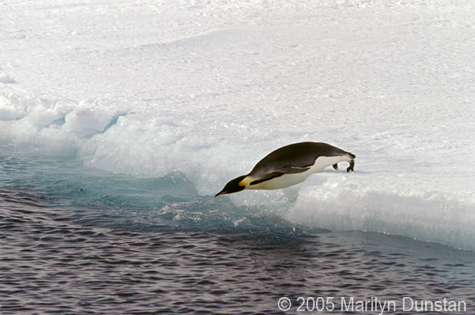
Emperor Penguin Diving onto Ice Shelf from Sea, Stancomb Wells Ice Edge, Weddell Sea, Antarctica (Image on Alamy.com)

In my last blog post “An Emperor Penguin Energy-Risk Model” on April 14, 2011, l discussed the predator-prey relationship between the leopard seal and emperor penguin in Antarctica. The leopard seal waits at the edge of the ice shelf and opportunistically picks off emperor penguins entering or leaving the sea. For the emperor penguin, feeding at sea is a decision between the need to feed to live and the risk of dying in the mouth of a leopard seal..

In the blog post I state: “From studying the emperor penguin and the leopard seal we know the emperor penguins will continue to feed, but so will the leopard seal. Some emperor penguins, despite their various risk protection strategies, will get eaten. It is important to note that in a probabalistic sense, we know that some penguins will be eaten by the leopard seal, but we don’t know which specific penguins will “bite the dust”.” This is true casually looking at a row of emperor penguins lined up to go into the sea in search of food.

However, upon closer analysis and study, over a period of time, it might be possible to determine which emperor penguins have a bit of catch in their step, have been injured in a narrow escape from a leopard seal, or have slowed down. These emperor penguins might come a belly-flop short of landing on the ice, and end up as prey in the mouth of a leopard seal. However, it is also possible, that a healthy, fit, member of the emperor penguin colony might suffer a particularly ill-fated episode of bad luck. This penguin might be in the wrong place at the wrong time when the leopard seal is rising out of the water with its mouth wide open ready for business. In fact, you could have the emperor penguin equivalent of the 4.0-40 yard dash champion, and end up as leopard seal “dinner”, with some bad luck and timing.

Looking at emperor penguin energy-seeking behavior and risk, it becomes apparent that probabilities have a great deal to do with the outcome but are not deterministic. You may attach a relatively higher probability of being eaten to the more fragile members of the emperor penguin population and a relatively lower probability of being eaten to those fitter members. The larger the colony size, and the more emperor penguins entering the sea at the same time, the lower the risk, the probability of being eaten, for any particular emperor penguin as there are more penguins entering the sea. (“there’s safety in numbers”).

You can run scenarios with differing proportions of fragile and fit emperor penguins, with higher and lower probabilities of being eaten (mortality rates), varying degrees of illness (morbidity rates) or accident, including leopard seal attack. In such scenarios, the leopard seal would most likely pick off different emperor penguins each time the scenario is run, however there would be objective tendencies to pick off more members of the more fragile group versus those of the fitter group.

In performing mathematical modeling of the fate of the emperor penguins by running scenarios with objective data and assumptions, we may set up a stochastic process which helps us to understand the behavior of the system as it evolves under a variety of scenarios.

Mathematical models involve expressing real world problems in mathematical language. This entails defining variables and establishing a formulaic process which will express the model as evolves. Variables are elements in the model which may change during the model. Because they may change, the model needs to calculate how they change over the course of the model and how they interact with other model variables, and are affected by the constants assumed by the model. Constants may arise from established data or may be assumptions plugged in to the model.

Stochastic processes incorporate non-deterministic, random elements into a mathematical model. The result may vary with time and with each model run. In comparison, a deterministic model will always produce the same result given the same assumptions and initial state. Thus, a stochastic process is run using random processes, employing a variety of assumptions and probability distributions informing objective tendencies for various model events to occur..

The random process in stochastic modeling will randomly choose which penguins are attacked, survive, suffer morbidity or injury from accident, and die over a period of time. Each run will be unique, as specific, members of the colony are differently impacted by the random process each time. By running many such models, one can get a picture of the survival data for the colony as a whole under a wide range of assumptions. Depending on the characteristics of the data, model and variables, results may be similar on an overall group basis, while differing by individual members impacted over time.

Under a normal range of assumptions and outcomes, this model may well predict overall group behavior over a period time. However modeling becomes much challenging when very low probability events enter into the model or rear their head in actual life.

For example, a eruption of an Antarctic volcano may be infrequent, however it could certainly impact emperor penguins. If the model assumed a volcanic eruption with a low probability, a robust number of stochastic model runs may randomly select such an event resulting in a BBQ penguin supper for the leopard seals.

The objective of the stochastic processes is to help us inform our decision making process, to help us understand the impact of variables under a wide range of assumptions, conditions, and scenarios. Thus a stochastic process should inform us about the expectations of the model under a wide variety of conditions, including the impacts of low probability / high risk events.

Thursday, April 14, 2011

An Emperor Penguin Energy-Risk Model


Emperor Penguin Preparing to Dive off Riiser-Larsen Ice Shelf (Image on Alamy)

The emperor penguin (aptenodytes fosteri) is the largest of the penguin species and lives in Antarctica in large colonies. Emperor penguins live in the harshest of climates in Antarctica, where the temperatures can get down to 40 degrees Fahrenheit and with strong winds up to 89 mph, developing a sizable wind chill factor. The penguin breeding colony stays together during the harsh winter, constantly churning the boundaries of the colony, sustaining the group.

The female emperor penguin lays one egg, which is nurtured by the male while the female returns to sea to fish. The male will then nurture the young chick in his brood pouch. Later, both parents take turns hiking to the ice shore, diving into the Antarctic waters, in search of food. Fish and crustaceans such as krill provide sustenance for the penguin, energy to keep it going.

This source of penguin energy is available from “the deep”. Lots of krill. Lots of fish. Lots of energy to power penguins. One catch. A predator. The leopard seal (Hydrurga leptonyx). The leopard seal is a large mammal (between 400 and 1300 pounds) that attacks the emperor penguin, often at the edge of the ice where it can make opportunistic kills. This video by BBC Earth shows the interaction between a leopard seal and emperor penguins.


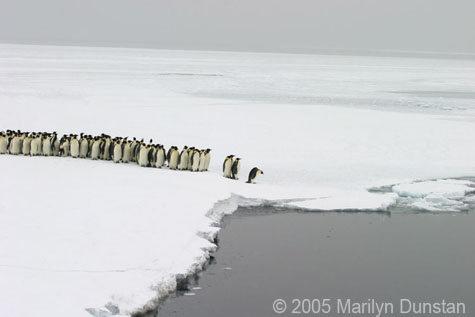
Emperor Penguins Lining up to Dive into water at Halley Bay Ice Edge (Image on Alamy)

A decision by an emperor penguin to dive into the water at ice’s edge is a decision to face a risk of being killed by the leopard seal or starve. Emperor penguins will accumulate in a line at the edge of the ice, waiting to take off, en-masse, into the water to feed. A tipping point is reached at some point where the shared risk of the group warrants all exiting off the ice edge into the cold deep, in quick succession. Feeding takes place in the open water and the emperor penguins quickly launch themselves through the air as they exit the water to land on the ice edge. They are playing the odds.

The emperor penguin’s appearance manages its risk to a certain extent. The emperor penguin’s black and white exterior helps to mitigate risk. The penguin’s black back appears lost looking downward against the black background of the marine deep. Looking upward from below, the emperor penguin’s white belly may be lost in the white glare of the water surface. This provides some degree of camouflage.

The penguins’ group decision, so neatly balanced in their emperor penguin-risk-matrix minds conceptually captures the “weighing of risks” issue as regards satisfying their energy needs. The penguin needs to take risks in order to eat, to supply energy, in order to live.

Food, after all, supplies energy that keeps us in business just as the various types of fossil fuels, nuclear energy and alternative energy sources provide energy for us to meet our various needs.

Our planet seems to shrink around us with population growth, economic development, energy demand and climate change challenges. As we seek to manage our lifestyles in this challenging environment, we are not unlike the emperor penguin. We face risk in pursuing our energy wants and needs.

We can analyze the risk patterns associated with the various energy choices that we have. These risk patterns vary considerably depending on which mix of energy resources are employed.

From studying the emperor penguin and the leopard seal we know the emperor penguins will continue to feed, but so will the leopard seal. Some emperor penguins, despite their various risk protection strategies, will get eaten. It is important to note that in probabalistic sense, that we know that some penguins will be eaten by the leopard seal, but we don’t know which specific penguins will “bite the dust”.

Similarly, as we explore various energy choices, we need to study the associated risks. We need to anticipate risks that may happen and proactively build defenses against them. However, we are kidding ourselves if we think that we can forever eliminate all such risks. It is the nature of evolving life to defeat such a worthy goal, as accidents can happen. It may be possible to predict the fact that accidents may happen while at the same time not being able to pinpoint exactly where or when they may occur. This consideration lends itself to a more global view of risk management, rather than focusing on any one particular potentiality.

In considering the risks associated with expanding energy sources to meet demand, its also appropriate to bring up ways to reduce energy demand, to become more efficient, to do more with what we have. This option becomes more attractive as the costs of the alternative options increases.

Monday, March 28, 2011

Energy Choices and Risk


Japan’s March 11, 2011 Tohoku 9.0 earthquake, ensuing tsunami and nuclear incident at Fukushima Daiichi Nuclear Plant have reminded us all that nuclear plants are subject to risk. This should be no surprise, as all sources of energy are subject to some degree of risk. In fact, just about everything in life has some degree of risk attached to it. However, nuclear plants, with their added radioactivity risk, present a considerable challenge in managing the lower probability, higher impact events.

We face global, environmental challenges in managing climate change issues. These climate change issues affect both micro-climates and have a planet-wide impact. In order to meet these considerable challenges, nuclear energy must be a part of the solution along with other energy options. We must seek to understand and mitigate risks facing nuclear plants as we go forward to solve the larger planet-wide problem which affects us all.

It has been almost 25 years since the April 26, 1986 nuclear incident at Chernobyl, in the Ukraine. That incident was ranked at “7” on the International Event Scale. The Three Mile Island Accident, beginning on March 28, 1979 ranked as a “5”. That incident, occurring exactly 32 years ago, took place at the Three Mile Island Plant in Middletown, Pennsylvania. The Fukushima Nuclear Accidents have so far been ranked as high as a “5”, and the situation has not yet been resolved .

In the midst of the efforts to bring the Fukushima Reactors under control, there have been calls to reexamine the safety of nuclear power plants. The International Atomic Energy Agency (IAEA) called for a meeting before the summer to discuss an assessment of the Fukushima accident, lessons to be learned, strengthened safety measures and strengthened responses to future incidents.

As the Japanese workers worked on the reactor, rating agencies Moody’s Japan K.K. and Standard and Poors downgraded Tokyo Electric Power Company (Tepco’s) long term debt. Moody’s indicated that it saw risk in GE’s nuclear business, although it did not downgrade GE, which contributes 1% of GE’s annual $100 billion revenue. GE was the designer of the Fukushima nuclear power plants., and the supplier of reactors 1,2 and 6.

At the same time, ongoing issues regarding the storage of the nation’s nuclear waste are unfolding. This waste includes waste from commercial nuclear plants and military/defense waste products. The waste is stored in a variety of locations, ranging from storage on site to storage at the Hanford Site, in Washington State, where two-thirds of the nation’s high-level radioactive waste is stored. The storage issues are complex, involving the removal of the nation’s only designated nuclear waste repository from consideration, and related litigation by states (Washington and South Carolina) and regulators (National Association of Regulatory Utility Commissioners).

We should develop an energy strategy that optimizes the risk profiles of the various types of power generation (including nuclear). This strategy should be science-based, above politics, in the interest of the nation (and world) as a whole, reflecting our responsibilities to the environment both in theory and in practice, and appropriately reflecting risks in pricing decisions.