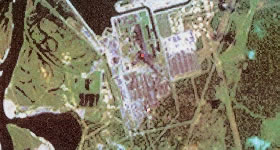
An aerial view of Chernobyl Nuclear Power Plant in April, 1986, with the red glow towards the center showing the heat from Unit #4. Source: epa.gov
The Chernobyl Disaster was a nuclear accident which occurred on April 26, 1986. It occurred in the Ukraine Republic (formerly part of the former USSR (Soviet Union)). Now the Chernobyl site is part of the country Ukraine. Today marks the 25th anniversary of the Chernobyl disaster.
It is particularly compelling to consider the impacts of Chernobyl today, twenty-fives years later, as we witness the unfolding of another nuclear disaster at Fukushima, Japan, following the 9.0 earthquake and tsunami on March 11, 2011. The two disasters arose from different circumstances and unfolded differently, however they share in common the impact of a low probability-high risk event.
They are set apart in both time and space, one occurring in vastness of the then-Soviet Union; the other set on the more densely populated island of Japan. The Chernobyl Disaster and the Fukushima disasters were both were graded as a 7 on the International Nuclear Event Scale. (Fukushima was raised from a 5 to a 7 on April 12, 2011, one month and a day following the earthquake and tsunami on March 11th).
How do we fathom such events as we seek to understand the risks of pursuing nuclear energy? How do we internalize these low probability-high risk events so that we carefully assess risks yet do not fall prey to unwarranted fears and suspicions? Do we hide our heads in the sands of improbability and ignore the potential of a very small yet very dangerous risk? Do we pour millions and billions of dollars to hedge against a risk that may never, in our lifetime occur? Do we even care about the impact of our decisions on those ancestors who may follow us many generations down the turnpike?
It is critical how we answer these questions, because our fate and the fate of our planet may hang in the balance. With the burgeoning population on this planet, the growing scarcity of resources, and the challenges presented by rising carbon dioxide levels, and other indications of planetary strain, we must find a way to make informed decisions that appropriately incorporate the low probability/high risk event in our search for and use of energy resources.
In my last blog posting, Emperor Penguin Energy-Risk Model - Part 2 , I discussed mathematical modeling, random variables and evolved a stochastic model of emperor penguin energy-risk behavior. I discussed some of the variables that may be considered in the emerging emperor penguin population, including mortality, morbidity and accident. I introduced the concept of a low probability event into the model (an eruption of an Antarctic volcano), and discussed the values of the stochastic process in informing results. The post was intended to discuss energy seeking behavior in a different (emperor penguin) population as an energy seeking risk example using stochastic modeling.
In my last post I stated “The objective of the stochastic processes is to help us inform our decision making process, to help us understand the impact of variables under a wide range of assumptions, conditions, and scenarios. Thus a stochastic process should inform us about the expectations of the model under a wide variety of conditions, including the impacts of low probability / high risk events.”
However, a stochastic process cannot inform without reasonable assumptions. Assumptions must be developed to allow the stochastic process to produce a credible range of results that will indeed be informative for the intended usages. There are many variables to consider, and assumptions to be made in analyzing risk. For a variety of reasons it may be difficult to obtain a robust set of assumptions that everyone agrees with for all potential uses.